























































File Prep 101: Resolution, Bleed & CMYK vs RGB Explained
In commercial printing and custom packaging across the United States, the bridge between creative concept and mechanical manufacturing is the


For growing corporate enterprises, nationwide franchise networks, healthcare systems, retail chains, and educational institutions, managing high-volume print runs is a vital operational challenge. Relying on short-run digital copy shops or fragmented vendor networks quickly leads to inflated unit costs, inconsistent paper stocks, and erratic color reproduction across branches. Transitioning to dedicated bulk printing services centralizes production, standardizes your brand presentation, and unlocks significant economies of scale that drive down the cost per piece as quantities rise.
Sourcing high-volume runs requires more than simply multiplying an order count. True volume printing demands industrial-grade offset presses, automated inline finishing, and strict color-management profiles that ensure the final sheet matches the first. Understanding the mechanical differences between high-capacity sheetfed offset and production digital presses, optimizing paper caliper selections, and preparing prepress files correctly empowers procurement officers, marketing directors, and business owners across the United States to maximize budget efficiency without compromising quality.
High-volume commercial print economics function fundamentally differently from standard desktop or quick-copy operations:
Certain business assets yield maximum financial return and operational convenience when ordered through dedicated business printing services:
| Production Factor | High-Volume Sheetfed Offset | Short-Run Production Digital |
|---|---|---|
| Optimal Quantity Range | 1,000 to 100,000+ Units | 25 to 500 Units |
| Unit Price Curve | Plummets significantly as volume climbs | Remains relatively flat across quantities |
| Tooling & Setup Overhead | Requires physical CTP aluminum plates | Plate-free direct imaging |
| Color Fidelity Standard | Exact PANTONE / PMS spot ink matching | Approximated 4-color process toner/liquid ink |
| Stock Versatility | Handles wide range of calipers & weights | Limited to heat-resistant digital-certified stocks |
| Turnaround Dynamic | Requires initial plate & press setup time | Rapid immediate same-day/next-day proofing |
Selecting the appropriate paper stock balances sensory weight with practical mailing and transit economics:
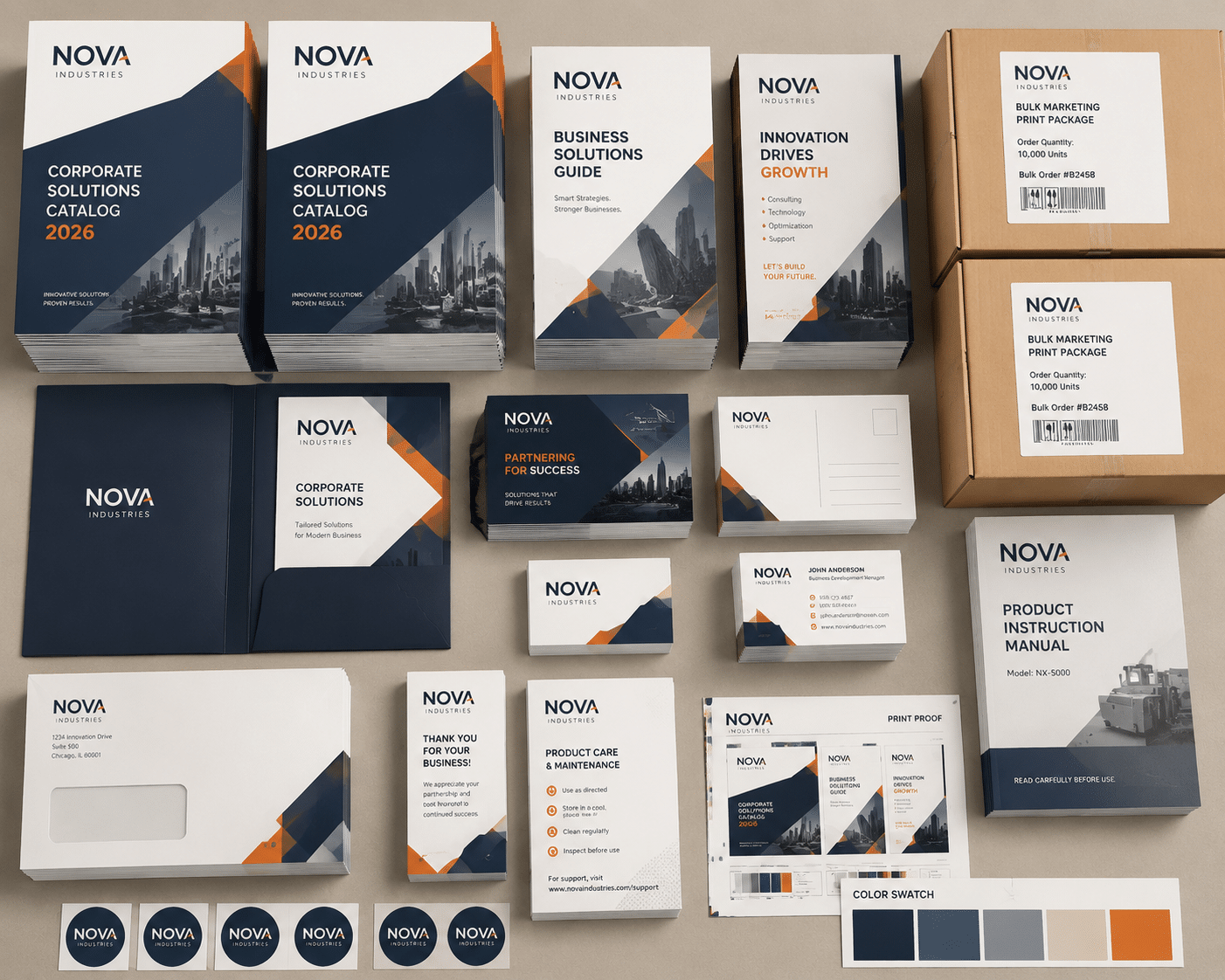
Catching an artwork error on a short run is an inconvenience; catching an error across 20,000 printed sheets is a costly disaster. Rigorous prepress file hygiene is essential:
Consolidating your organization’s diverse collateral into unified bulk press schedules streamlines fulfillment and maximizes your procurement budget:
Executing high-volume print runs without delays, color variance, or finishing errors requires a commercial printing partner with industrial offset presses, automated post-press tooling, and dedicated prepress oversight.
At Printin Budget, we provide enterprise-level bulk commercial printing and custom marketing manufacturing engineered to help your business scale efficiently. Our prepress technicians inspect every digital file, bleed margin, and color build before plates are imaged to ensure clean registration and dependable print fidelity.
Whether you need a replenishment run of thousands of multi-panel brochures for a multi-state sales team or mass quantities of administrative stationery for an entire health system, we deliver consistent materials, competitive volume pricing, and dependable delivery to support your commercial goals.
Connect with Printin Budget today to review your print quantities, discuss custom paper stocks, or request an enterprise volume quotation for your upcoming project.
1. What threshold defines a print job as bulk or volume printing?
While definitions vary by product, bulk printing typically begins at 1,000 to 2,500 units for items like brochures, flyers, and postcards, and 500 to 1,000 units for presentation folders and multi-part business forms. At these quantities, running on offset presses becomes significantly more cost-effective than digital printing.
2. Why does the unit price decrease so drastically with high-volume orders?
The major expenses in commercial offset printing come from upfront mechanical preparation—such as imaging plates, setting ink densities, and calibrating registration. Once the press is rolling at speeds up to 15,000 sheets per hour, the cost of adding extra units is primarily just the paper and ink consumed.
3. What is the standard bleed and safe zone requirement for commercial print files?
All high-volume artwork files require a standard 0.125-inch bleed extending past the final trim boundary on all four outer edges. Critical typography, contact numbers, and logos should remain at least 0.125 inches (or 0.25 inches for large documents) inside the trim line within the safe zone.
4. Can bulk orders be split-shipped to multiple office locations?
Yes. Enterprise bulk printing services regularly offer split-shipment and drop-shipping logistics, allowing organizations to capitalize on the lower per-unit cost of a single massive production run while shipping allocated cartons directly to different regional branches.
5. How does offset color consistency compare to digital toner printing across large quantities?
Commercial sheetfed offset printing provides unmatched color consistency across large runs. Digital toner can fluctuate slightly as fuser temperatures shift during extended cycles, whereas offset presses utilize constant mechanical ink keys, dampening systems, and densitometer monitoring to ensure precise color fidelity across tens of thousands of sheets.
In commercial printing and custom packaging across the United States, the bridge between creative concept and mechanical manufacturing is the

For commercial general contractors, civil engineering teams, sports facilities, municipal agencies, and outdoor event organizers across the United States, displaying

In retail promotions, corporate real estate, commercial contracting, and community event marketing across the United States, large-format physical signage delivers