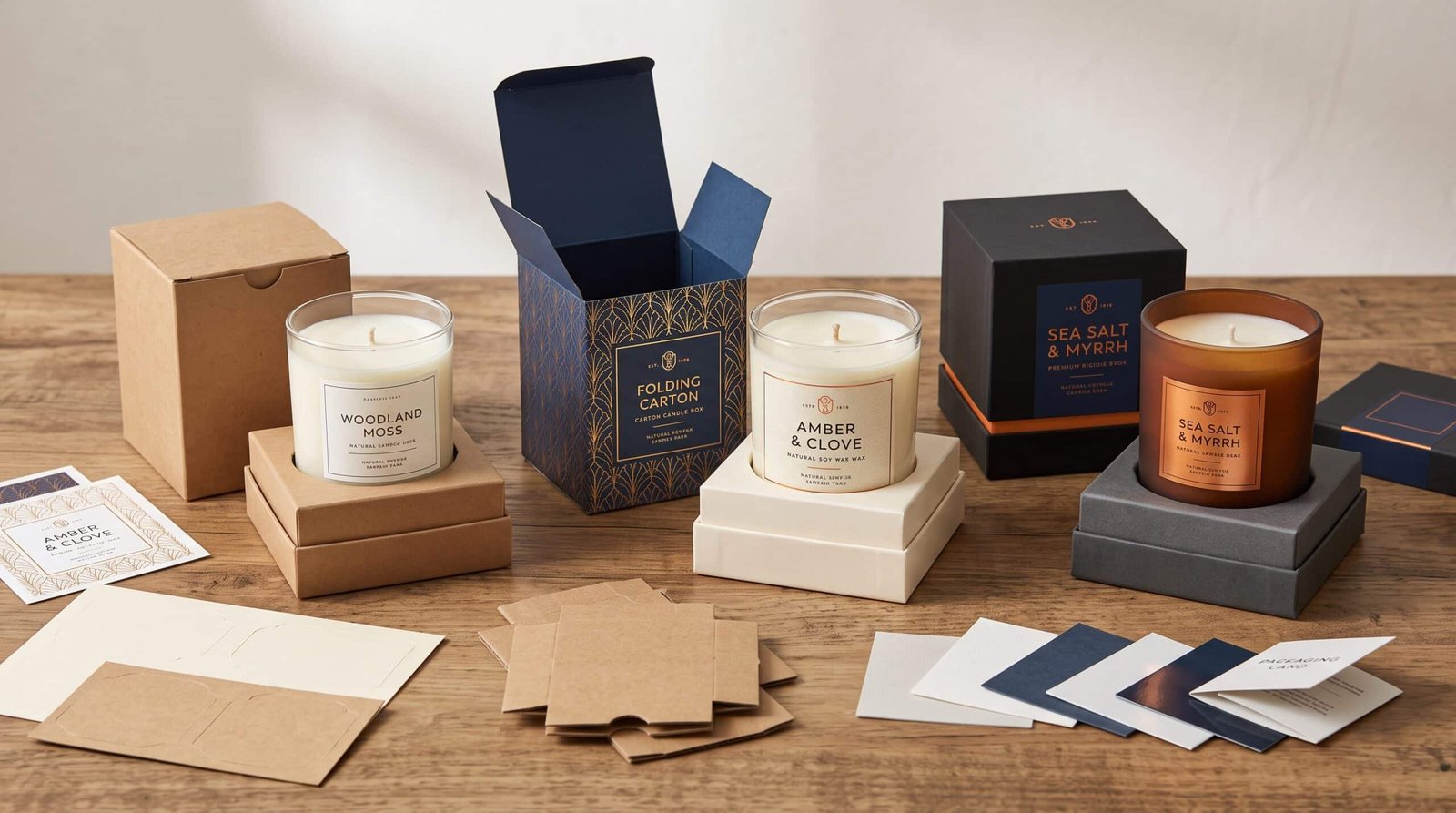
How to Choose Custom Candle Packaging: Selecting the Ideal Box Style, Insert, and Label Combinations
For artisan chandlers, luxury home fragrance houses, and independent candle studios across the United States, developing a signature scent is only half the journey toward building a profitable retail business. Fragrance vessels present serious logistics challenges: hand-poured soy, coconut, or beeswax contained within heavy soda-lime glass tumblers, delicate ceramics, or metal tins are dense, fragile, and sensitive to temperature shifts. Shipping or retailing delicate jars inside thin, uncalibrated cartons leads to broken glass in transit, dented edges on retail display shelves, and oil-stained paperboard that permanently damages customer perception. Engineering dependable custom candle packaging requires coordinating three structural elements: the external folding carton, an internal shock-absorbing insert, and a heat-resistant container label.
A mismatched packaging combination often results in broken inventory or product returns. High-end glass vessels require specialized base structures that will not burst under pressure, custom-engineered inserts to prevent lateral shifting during postal transit, and label adhesives that withstand both essential oils and high heat. Understanding how to design candle boxes, selecting matching paperboard calipers, and planning prepress dielines in inches empowers home fragrance businesses, apothecary brands, and boutique retail lines throughout the United States to safeguard fragile inventory, comply with fire safety laws, and deliver an engaging sensory unboxing experience.
The Three-Component Architecture of Fragrance Packaging
High-performance candle packaging functions as a complete, three-part system where each layer handles a distinct protective and visual job:
The Outer Structural Shell: The external folding carton or rigid box that provides compressive vertical stacking strength, carries legal safety disclosures, and creates the primary visual impression on store shelves.
The Internal Cushioning Insert (Cradle): A precision die-cut collar, riser, or foam cavity that suspends the vessel in the center of the box, creating a protective buffer against external drops.
The Primary Vessel Label: The pressure-sensitive label applied directly to the glass tumbler, ceramic jar, or metal tin, engineered to resist heat, flame proximity, and fragrance oil saturation.
The Protective Exterior Coating: A water-based aqueous seal or thermal film lamination applied over outer inks to resist scuffing, edge wear, and transit friction.
Choosing the Right Box Style: Auto-Lock vs. Straight Tuck vs. Two-Piece Rigid
Selecting the correct structural silhouette depends directly on vessel weight, assembly speed, and retail price point:
Auto-Lock Bottom (Crash-Lock Base) Cartons: The commercial standard for heavy glass tumblers weighing between 8.0 ounces and 24.0 ounces. The bottom flaps are pre-glued in a folding pattern that automatically locks into an interlocking floor when the box is popped open, ensuring the heavy base will not push through during handling.
Straight Tuck-End (STE) Cartons: Both the top and bottom closure flaps fold toward the back of the carton, leaving a smooth front panel uninterrupted by die-cut seams. Best suited for lightweight travel candle tins, wax melt clam shells, or compact votives under 6.0 ounces.
Two-Piece Rigid Setup Boxes: Constructed from dense 40pt to 60pt structural chipboard wrapped in printed fine-art paper. Featuring a separate telescoping lid and solid base tray, this box style delivers an upscale unboxing experience favored for luxury gift sets.
Reverse Tuck-End (RTE) Cartons: A practical option where the top flap folds back and the bottom flap folds forward, allowing efficient sheet nesting during high-volume commercial production runs.
Side-by-Side Breakdown: Outer Box Architectures for Candle Packaging
Engineering Metric
Auto-Lock SBS Folding Carton
Two-Piece Rigid Setup Box
Straight Tuck-End (STE) Carton
Material Thickness
18pt to 24pt SBS (0.018 to 0.024 inches)
40pt to 60pt Wrapped Greyboard
16pt to 18pt Folding Boxboard
Vessel Weight Capacity
Supports up to 2.5 lbs comfortably
Supports up to 5.0+ lbs comfortably
Supports up to 0.75 lbs comfortably
Fulfillment Footprint
Ships flat; instant pop-open setup
Ships pre-assembled (higher freight)
Ships flat; fast manual assembly
Drop-Shock Resistance
Moderate to high (with internal insert)
Maximum exterior rigid protection
Low (for lightweight vessels only)
Optimal Price Category
Mid-to-high-tier boutique candles ($24–$55)
Luxury, high-end collector vessels ($60–$150+)
Travel tins, tea lights, and wax melts ($8–$20)
Internal Insert Engineering: Corrugated Buffers, SBS Collars, and Custom Foam
A common cause of transit breakage is loose space inside the box that allows the heavy glass container to strike the outer paperboard:
Die-Cut SBS Paperboard Platform Collars: A scored cardstock sheet (18pt to 24pt) folded to create a suspended platform with a circular center cutout matching the vessel’s diameter (e.g., 3.125 inches). It keeps the candle centered and prevents movement with minimal material waste.
E-Flute Corrugated Shock Sleeves (0.0625 inches thick): An internal fluted corrugated liner that lines the perimeter walls of the outer box, adding crush resistance against heavy parcels stacked on carrier belts.
Custom CNC-Cut High-Density EVA Foam: A dense, velvet-topped or matte micro-cell foam block cut to the precise silhouette of the glass jar, providing maximum impact protection for expensive crystal vessels and delicate ceramic lids.
Thermal Buffering Air Pockets: Engineering a 0.25-inch to 0.5-inch air cushion between the vessel and the exterior box walls prevents sudden outside temperature shifts from causing wax sweating, blooming, or jar cracking during winter shipments.
Selecting Primary Vessel Labels: Heat Resistance and Essential Oil Protection
Labels applied directly to candle tumblers face high radiant glass heat during burning and exposure to natural fragrance oils during filling:
White & Clear BOPP Synthetic Films: Biaxially Oriented Polypropylene is the premier label stock for candle vessels. BOPP does not absorb moisture, resists melting under container temperatures up to 200°F (93°C), and will not discolor from spilled essential oils.
Estate No. 8 & Wet-Strength Textured Papers: A fibrous paper stock that gives apothecary and botanical candles a vintage, textured appearance. It must be paired with an inline protective varnish to prevent natural oils from leaving dark grease spots.
Heat-Resistant High-Tack Acrylic Adhesives: Standard packaging adhesives can soften and slip down the glass when a candle burns down to its base. High-tack, heat-resistant adhesives maintain their bond on smooth, warm glass surfaces throughout the life of the candle.
Protective Matte or Gloss UV Laminations: A transparent top-laminate film that prevents hot wax drips from dissolving printed CMYK graphics, ensuring the brand emblem and scent name remain legible.
Recommended Combinations: Matching Box, Insert, and Label by Candle Type
Pairing the right components depends on the shape of your vessel, weight, and retail sales channel:
The Everyday Luxury Tumbler (8.0 oz to 11.0 oz Glass):
Box Style: 20pt SBS Auto-Lock Bottom Carton with velvet soft-touch finish.
Insert: Scored 20pt SBS bottom platform insert with a circular cutout.
Vessel Label: Matte-laminated white BOPP roll label with a high-tack acrylic adhesive.
The Multi-Wick Statement Jar (16.0 oz to 26.0 oz Glass or Ceramic):
Insert: No insert required; size the box to fit the tin dimensions with a 0.0625-inch buffer.
Vessel Label: Full-coverage Estate textured paper wrap label paired with a circular lid label.
Prepress Technical Setup: Vector Dielines, Score Allowances, and Clearances
Submitting accurate prepress production files guarantees that outer cartons, inserts, and roll labels fit together seamlessly:
Dedicated Vector Dieline Layer: Place the box and insert dielines on a dedicated, non-printing top vector layer named “DieLine”, using solid red lines for through-cuts and dashed green lines for mechanical scores.
0.125-Inch Bleed Past Trim Lines: Extend all background colors, illustrations, and patterns at least 0.125 inches outside all cut perimeters and tuck flaps to prevent raw white edges after automated die-cutting.
0.125-Inch Safe Zone Buffer: Keep all scent descriptions, legal warnings, net weights, and barcodes at least 0.125 inches away from all fold creases, scores, and perimeter cuts.
Accounting for Paperboard Caliper in Inserts: When designing an internal insert, size the insert’s outer footprint 0.0625 inches to 0.125 inches smaller than the box’s internal dimensions to allow for smooth assembly without buckling the outer walls.
300 DPI Resolution & Native CMYK Builds: Lock all raster photography and renders at 300 dots per inch at 100% scale in native CMYK to ensure sharp edge definition across micro-typography.
Legal Compliance: ASTM Fire Safety and Fair Packaging Mandates
Retail candle packaging distributed throughout the United States must balance attractive branding with mandatory consumer safety disclosures:
ASTM F2058 Fire Safety Warning Standards: Every candle sold must carry a clear safety warning panel (typically placed on the base of the vessel or the bottom panel of the outer box). This includes the standardized triangular alert symbol and the three mandatory warning pictograms: Burn within sight, Keep away from flammables, and Keep away from children and pets.
Fair Packaging and Labeling Act (FPLA) Rules: The primary display panel must declare the net product weight in both US Customary ounces and metric grams (e.g., “Net Wt. 8.5 oz / 240g”) in the lower third of the front panel in a clear, contrasting font.
Manufacturer Identification: State the legal business name, street address, city, state, and zip code of the candle manufacturer, distributor, or brand house.
Wick Trimming & Burn Instructions: Explicitly state the 0.25-inch wick-trimming directive and the 4-hour maximum burn-cycle threshold to prevent glass overheating and soot accumulation.
Coordinated Collateral to Complete Your Home Fragrance Ecosystem
To maintain an interconnected website architecture and support balanced crawl depth without orphaned pages, pair your candle packaging with these coordinated commercial print assets:
Fragrance Discovery Cards: Include branded scent guides, wick-care instructions, and new seasonal collection cards inside shipping boxes using thick luxury spot UV bookmarks.
Boutique Countertop Literature: Display seasonal fragrance notes, wholesale line sheets, and candle care steps beside register counters with sturdy countertop rack card displays.
Executive Administrative Correspondence: Issue formal distributor contracts, boutique wholesale invoices, and licensing paperwork on matching corporate business letterheads.
High-Impact Brand Displays: Highlight new seasonal scent launches at trade shows, farmer’s markets, and retail pop-up stores using portable retractable roll-up banner stands.
Promotional Direct Mail Collateral: Drive online reorders and announce limited-edition holiday scents by mailing targeted commercial promotional flyers directly to VIP customer lists.
Source Custom Candle Packaging Solutions with Printin Budget
Engineering durable, cleanly scored candle packaging requires a commercial manufacturing partner equipped with precision offset presses, automated die-cutters, and dedicated prepress oversight.
At Printin Budget, we manufacture professional custom candle packaging, auto-lock cartons, protective inserts, and heat-resistant vessel labels engineered to protect heavy glass jars and enhance brand presentation. Our prepress technicians inspect your vector dielines, insert tolerances, and bleed allowances before production begins to ensure clean mechanical folding and dependable structural performance for candle brands across the United States.
Whether you need a specialized run of soft-touch folding cartons for a boutique holiday collection or wholesale quantities of custom candle boxes for nationwide department store distribution throughout the United States, Printin Budget provides durable paperboard stocks, precise mechanical scoring, and dedicated account support.
Connect with Printin Budget today to download structural candle box dielines, explore protective insert options, or request an enterprise quotation for your upcoming project.
1. Why is an auto-lock bottom box recommended over a tuck-end box for candles?
Candles housed in glass or ceramic vessels are dense and heavy. An auto-lock bottom features pre-glued, interlocking base flaps that automatically snap into place, providing maximum downward load-bearing strength that prevents heavy jars from falling through the bottom.
2. What type of label material should be applied directly to a candle vessel?
White or clear BOPP (polypropylene) synthetic film is the best choice. It is heat-resistant up to 200°F (93°C), does not absorb spilled essential oils, and will not peel, wrinkle, or discolor as the candle burns down to the bottom of the jar.
3. Do candle boxes require an internal insert?
While not strictly mandatory for lightweight metal tins, internal inserts are strongly recommended for glass and ceramic jars. A die-cut cardstock collar or dense foam insert locks the jar in the center of the box, preventing it from striking the outer walls during transit and absorbing drop shocks.
4. What safety information must be printed on retail candle packaging in the United States?
Retail candle packaging must include the net weight in both ounces and grams on the front panel, the manufacturer’s name and location, and standard ASTM fire safety warnings (burn within sight, keep away from flammables, keep away from children/pets, and trim wicks to 0.25 inches).
5. How much smaller should an internal candle insert be compared to the outer box?
To ensure the insert slides into the carton without catching, binding, or bowing the exterior paperboard walls, engineer the outer perimeter of the insert to be approximately 0.0625 inches to 0.125 inches smaller than the internal dimensions of the outer box.
Related Blogs
Explore our latest blogs for insights, inspiration, and updates. Discover engaging stories, expert tips, and creative ideas designed to enrich your knowledge and spark curiosity across various topics.
For commercial general contractors, civil engineering teams, sports facilities, municipal agencies, and outdoor event organizers across the United States, displaying
In retail promotions, corporate real estate, commercial contracting, and community event marketing across the United States, large-format physical signage delivers