






















































Real Estate Printing: Marketing Materials for Real Estate Businesses
In residential real estate, luxury property developments, and commercial brokerage, physical print collateral establishes credibility, conveys property value, and drives

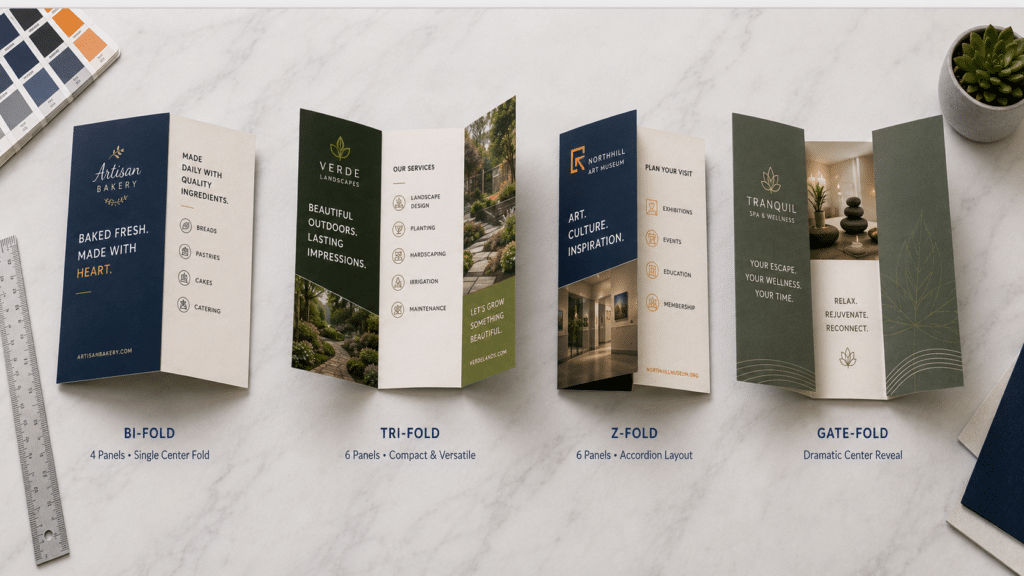
In commercial sales, trade show marketing, and corporate communications, brochures remain one of the most versatile physical collateral formats available. Unlike a flat single-sheet flyer, a multi-panel folded brochure invites tactile interaction, revealing information progressively as the reader opens each fold. However, choosing the wrong fold style for your content structure can confuse readers, disrupt your narrative flow, or cause awkward panel overlap during automated machine folding.
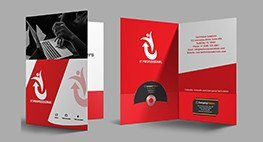
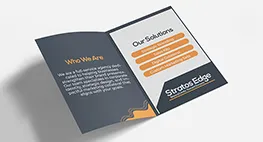
Selecting between popular brochure fold types—including tri fold brochure, bi fold brochure, z-fold, and gate-fold formats—requires understanding how physical fold lines dictate visual hierarchy. Each folding style creates a distinct pacing for your headlines, product photography, and service breakdowns.
This comprehensive layout guide explores the structural mechanics, panel dimensions, storytelling applications, and prepress standards for the four core commercial brochure styles to help you maximize your marketing return across the United States.
A commercial brochure begins as a flat, flat-printed sheet of paper that passes through precision mechanical scoring and buckle-folding equipment. The way paper fibers bend determines how smoothly the document opens and closes.
When planning your marketing collateral, matching your content volume to the folding mechanism is critical:
To review sizing options, commercial paper stocks, and high-volume volume discounts, explore our commercial brochure printing solutions.
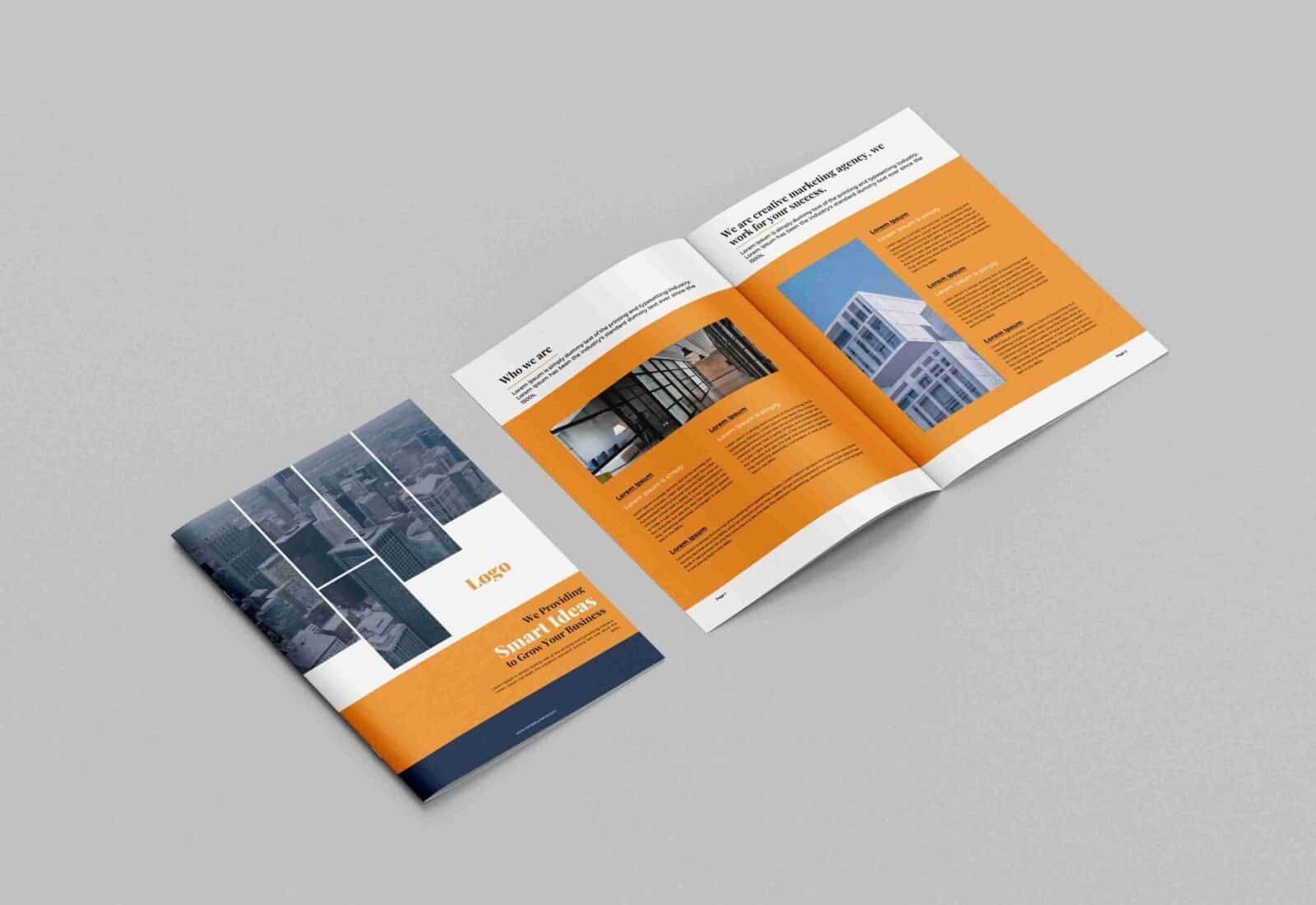
The bi-fold format (often built from an 8.5″ × 11.0″ flat sheet folded in half to 5.5″ × 8.5″, or an 11.0″ × 17.0″ sheet folded to 8.5″ × 11.0″) functions like a compact booklet.
Because it opens to reveal a wide, unified 2-panel interior spread, the bi-fold layout is ideal for:
The tri-fold brochure is the most widely distributed commercial format in North America. Typically produced from a standard 8.5″ × 11.0″ flat sheet, it folds into a sleek 3.687″ × 8.5″ vertical finished size.
The C-fold structure creates a step-by-step reading journey:
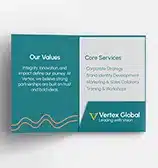
Unlike a tri-fold where panels nest inside one another, a Z-fold creates three alternating panels of identical width that pull apart in a continuous motion.
Because all panels are equal in size and both sides are immediately accessible, Z-fold layouts excel at:
The gate-fold utilizes two outer panels that meet flush in the middle of the sheet. When opened, both flaps swing outward simultaneously, creating a theatrical “unveiling” effect.
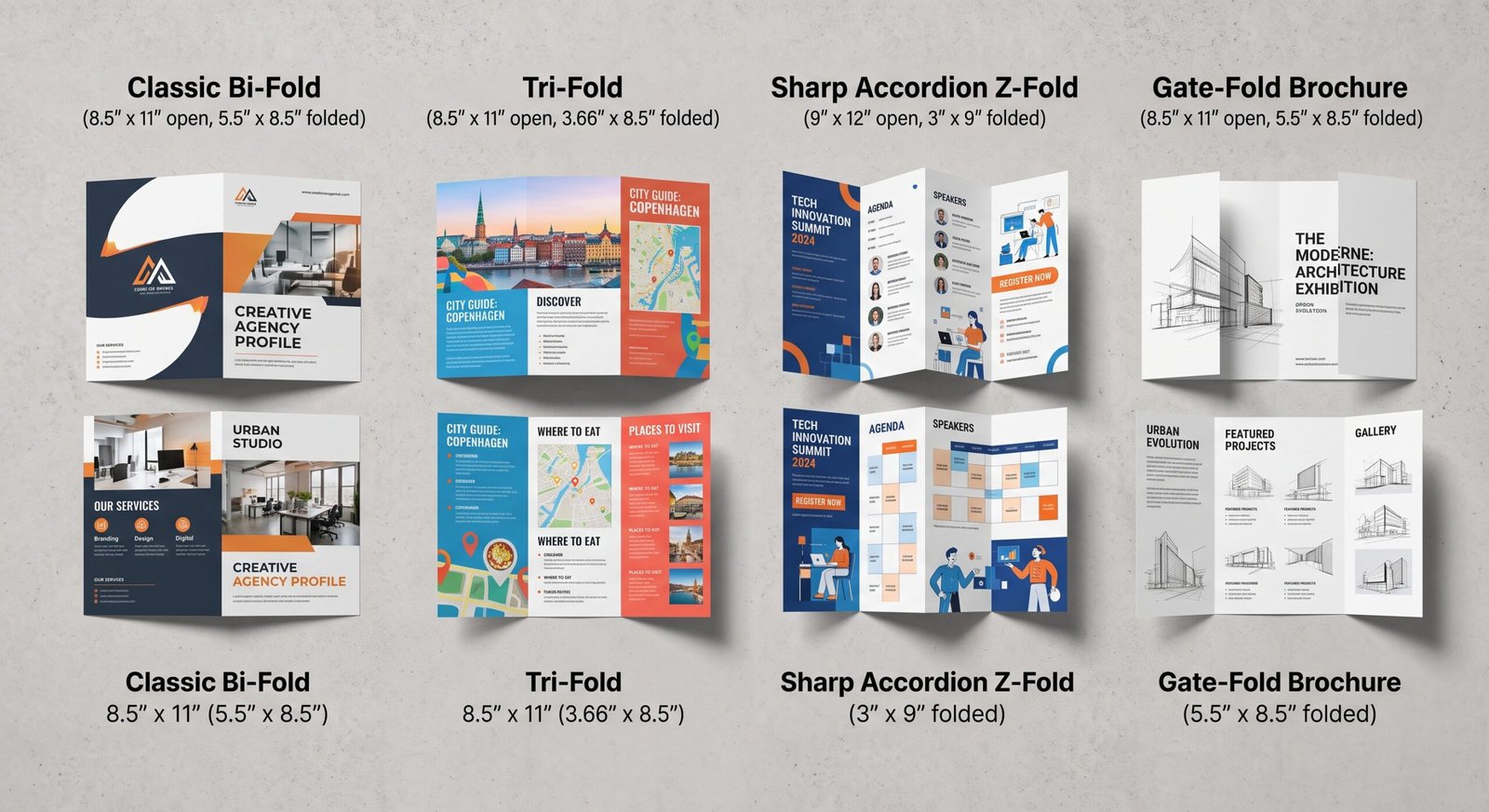
Selecting the correct fold style requires balancing your content density against your distribution method.
| Brochure Fold Type | Panels (Sides) | Standard Flat Size | Standard Finished Size | Primary Content Flow |
|---|---|---|---|---|
| Bi-Fold | 4 Panels | 8.5″ × 11.0″ / 11″ × 17″ | 5.5″ × 8.5″ / 8.5″ × 11.0″ | Book-style (Cover → 2-Page Spread → Back) |
| Tri-Fold (C-Fold) | 6 Panels | 8.5″ × 11.0″ | 3.687″ × 8.5″ | Step-by-step (Cover → Inside Flap → 3-Panel Inside) |
| Z-Fold | 6 Panels | 8.5″ × 11.0″ | 3.66″ × 8.5″ | Continuous flow / Panoramic accordion spread |
| Gate-Fold | 6 Panels | 8.5″ × 11.0″ / 11″ × 17″ | 4.25″ × 11.0″ / 8.5″ × 11.0″ | Theatrical reveal (Split Cover → Expansive Center Spread) |
The physical weight of your paper directly influences fold durability. Heavy paper stocks require commercial scoring prior to folding to prevent paper fibers from tearing or cracking along the spine.
Proper digital file setup ensures your typography, background colors, and fold lines align precisely with mechanical cutting and folding equipment.
Integrating folded brochures with matching business collateral creates a cohesive physical marketing presence across all corporate touchpoints in the United States.
Printing clean, high-precision folded collateral requires a commercial partner equipped with accurate scoring, sharp color reproduction, and high-speed folding machinery.
At Printin Budget, we print professional multi-panel brochures designed to help businesses communicate complex services clearly. Our prepress technicians review your panel widths, fold score alignments, and bleed margins before your order goes to press.
Whether you need a short run of luxury gate-folds for an executive product launch or wholesale quantities of tri-folds for nationwide retail distribution, we deliver durable paper stocks and attentive service to support your commercial goals.
Connect with Printin Budget to explore paper stocks, verify your folding template specifications, or request a custom printing quote for your project.
Q1: What is the main difference between a tri-fold and a z-fold brochure?
The main difference is the folding direction and panel sizes. A tri-fold (C-fold) has two parallel folds where the right panel folds inward and the left panel folds over it, requiring the inside panel to be slightly shorter (approx. 1/16″ to 1/8″) to avoid buckling. A Z-fold uses alternating accordion folds where all three panels are identical in width, opening outward in a continuous zigzag pattern.
Q2: Why does a tri-fold brochure require a shorter inside panel?
When a tri-fold closes, the innermost panel tucks inside the two outer panels. If all three panels were printed at the exact same width (e.g., 3.666 inches on an 11-inch sheet), the thickness of the paper would cause the inside panel to hit the outer spine crease, causing the brochure to bow or buckle rather than laying flat.
Q3: When should a business choose a bi-fold over a tri-fold brochure?
Choose a bi-fold brochure when your content features large photography, extensive charts, technical spec tables, or multi-page narratives that benefit from a wide, book-style 2-page interior spread. Choose a tri-fold when you need a compact, portable format that fits standard brochure racks, direct mail envelopes, or countertop displays.
Q4: Why is paper scoring necessary before folding heavy brochure cardstock?
Scoring creates a clean mechanical indentation along the fold line that compresses the paper fibers before bending. On heavy paper stocks (such as 100lb cover or 14pt+ cardstock), folding without scoring tears the surface paper fibers and cracks printed ink along the spine, resulting in rough, jagged edges.
Q5: What is the standard flat and finished size of a gate-fold brochure?
A standard gate-fold is typically printed on an 8.5″ × 11.0″ flat sheet (folding into a 4.25″ × 11.0″ finished size) or an oversized 11.0″ × 17.0″ flat sheet (folding into an 8.5″ × 11.0″ finished size). The two outer panels each measure roughly half the width of the central interior panel.
In residential real estate, luxury property developments, and commercial brokerage, physical print collateral establishes credibility, conveys property value, and drives

Selecting the right physical print format is one of the most critical decisions when launching a direct-to-consumer marketing or local

In service industries, field contracting, logistics, and wholesale commerce, generating instant physical documentation during client interactions remains critical for legal